Why the Safest Demolition Projects are the Ones Neighbors Barely Feel
A controlled demolition site doesn’t just focus on what’s coming down. It focuses on what’s standing nearby. During high-impact teardown work, vibration monitoring helps demolition crews track the movement of shockwaves through soil, foundations, and surrounding buildings in real time. In demolition in Vancouver WA, vibration monitoring has become one of the most important tools for protecting nearby structures, utilities, parking lots, and occupied properties during structural demolition projects.
Property owners often assume demolition damage comes solely from falling debris, but vibration can quietly travel through concrete structures and the surrounding ground long before visible cracking appears. That’s why experienced crews like A-1 Demolition & Hauling integrate monitoring into the demolition process itself.
Professional demolition uses vibration monitoring to measure ground movement and structural response during teardown. Sensors track vibration levels in real time, enabling crews to adjust demolition techniques, reduce stress on nearby buildings, and prevent damage from uncontrolled force transfer during high-impact demolition activities.
How Vibration Monitoring in Demolition in Vancouver WA Protects Nearby Buildings
Every demolition project creates energy. The moment concrete breaks or structural steel shifts, vibrations move through the surrounding environment. On isolated sites, that movement may not create major concerns. In dense urban settings or near aging office buildings, however, even moderate vibration can affect neighboring structures.
That’s where monitoring systems come in. Crews place sensors around the site to measure vibration velocity and structural movement as demolition progresses. These systems allow demolition contractors to identify unsafe thresholds before damage occurs.
People often ask, “Can demolition vibrations really crack another building?” Yes, especially during structural demolition involving concrete structures or heavy equipment. Repetitive small vibrations can weaken older materials or expose existing foundation issues. Monitoring helps prevent that chain reaction.
In Vancouver, WA, where residential demolition and commercial demolition often happen near occupied properties, vibration control is part of responsible site preparation and regulatory compliance.
Why Older Commercial Buildings Face Greater Vibration Risks
Not all structures respond to vibration the same way. Older commercial buildings, office buildings, and industrial facilities often contain aging concrete, brittle masonry, or outdated structural systems that are more sensitive to vibration stress.
Hidden Conditions Can Amplify Vibration Damage
Many neighboring properties already have existing settlement cracks or weakened supports. Demolition vibration doesn’t always create new damage—it sometimes exposes conditions already developing beneath the surface.
This is especially important during:
- Selective demolition
- Interior demolition
- House teardowns
- Structure Demolition near occupied sites
Professional demolition services evaluate surrounding structures before work begins so there’s a clear baseline condition. That documentation protects both the property owner and the demolition contractor.
According to the National Institute of Building Sciences, vibration monitoring is considered a best practice for protecting adjacent infrastructure during demolition and construction activity. Companies that ignore this step often unnecessarily increase their liability exposure.
Need Safe Demolition Services for a Sensitive Teardown Project?
Contact A-1 Demolition & Hauling today for expert demolition planning and protection.
The Science Behind Vibration Monitoring Most Property Owners Never See
Vibration monitoring sounds technical because it is. But the basic idea is surprisingly simple: measure movement before movement becomes a problem.
How The Monitoring Process Works
Geophones are positioned near adjacent structures, underground utilities, and critical areas around the demolition zone. These devices record particle velocity, frequency, and displacement during demolition activities.
Crews compare those readings against established safety regulations and engineering standards. If vibration levels rise too high, the demolition contractor can:
- Slow demolition activities
- Modify demolition techniques
- Change equipment positioning
- Reduce impact force
This real-time feedback turns demolition into a controlled process instead of a guessing game.
What High-Impact Demolition Looks Like Without Monitoring
Without monitoring, crews rely mostly on visual observation. The problem is that vibration damage often begins before visible signs appear.
Small Warning Signs Crews Can Miss
Hairline cracks around windows. Minor slab shifting. Subtle movement in retaining walls. These are early indicators that vibration loads may be exceeding safe levels.
On larger demolition projects involving:
- Concrete removal
- Site Clearing
- Deconstruction activities
- Full site clearing
- Debris removal
The risks multiply quickly if vibration isn’t tracked continuously.
That’s why experienced demolition contractors coordinate closely with excavators, dump truck fleet operators, and haul-off services teams. Monitoring protects the entire construction project, not just the demolition zone itself.
How Professional Demolition Teams Reduce Vibration Before Problems Start
The best vibration monitoring systems aren’t reactive—they’re proactive. Skilled crews plan demolition methods from the outset to minimize vibration.
Techniques that Minimize Vibration Transfer
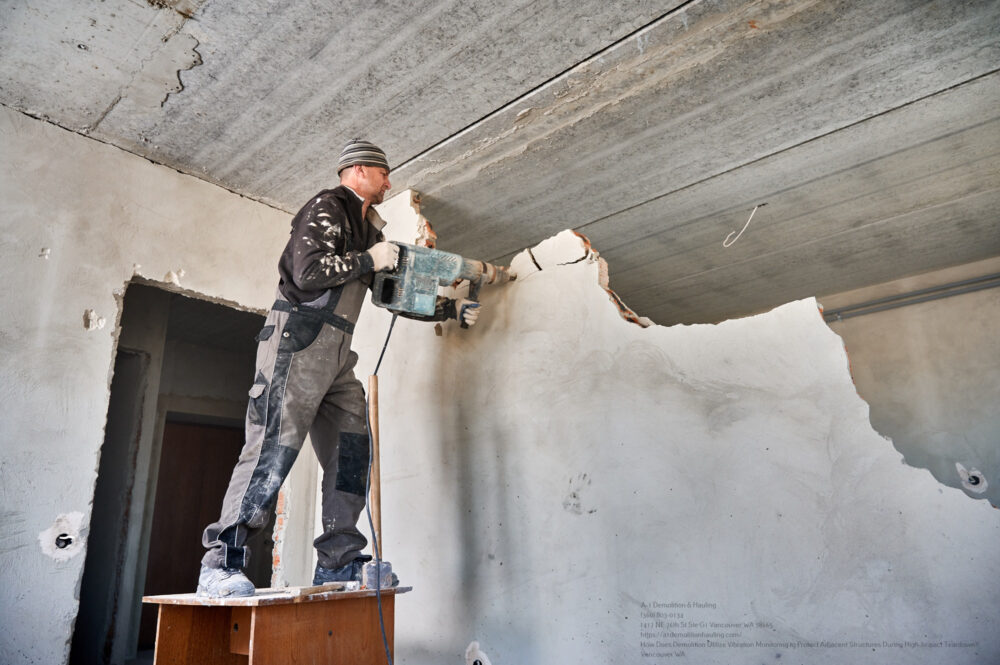
Selective building interior demolition often creates less vibration than full structural collapse because materials are removed gradually. Concrete cutting also reduces shock transfer compared to aggressive breaking methods.
Professional demolition teams may also:
- Sequence demolition to control energy release
- Use smaller equipment in sensitive zones
- Isolate impact areas near neighboring foundations
- Adjust work timing to protect occupied buildings
These adjustments matter even more in Vancouver WA, where mixed-use properties and tighter lot spacing create less room for error.
Why Waste Management and Vibration Control Often Work Together
Most people separate demolition from waste handling, but the two are closely connected. Poor debris management can increase vibration loads across a site.
Heavy Debris Changes the Site Pressure
Construction and demolition (C&D) debris, bulky waste, and inert waste create temporary loading conditions that affect soil behavior. When materials pile unevenly near sensitive structures, vibration effects can intensify.
That’s why professional demolition contractors coordinate with:
- Recycling company partners
- Transfer stations
- Disposal facility operators
- Waste Connections
- G-Certified hauler services
Efficient haul-off services using side-dump trucks and conveyor systems reduce unnecessary vibration and keep the site stable throughout the demolition process.
What Smart Property Owners Look for Before Hiring a Demolition Contractor
Property owners often focus on price first. The smarter question is this: how does the contractor manage risk?
Questions Worth Asking Before Demolition Starts
Does the contractor monitor vibration? Do they document neighboring structures beforehand? Are they familiar with asbestos removal, hazardous waste handling, and Washington Utilities and Transportation Commission requirements?
Experienced companies answer these questions confidently because vibration monitoring is already part of their operations. A licensed general contractor understands that protecting adjacent properties is just as important as removing the target structure itself.
Why Choosing A-1 Demolition & Hauling is the Smart Decision
We at A-1 Demolition & Hauling provide the best solutions to our customers by combining careful demolition planning with modern vibration monitoring practices. Our demolition services are designed to protect nearby structures, reduce unnecessary risk, and keep projects moving safely from start to finish.
Our team handles structural demolition, selective demolition, interior demolition, concrete removal, site clearing, and debris removal with a strong focus on safety protocols and regulatory compliance. From commercial buildings and industrial facilities to residential demolition and house teardowns, we approach every project with precision and accountability.
We proudly support safe demolition practices through responsible recycling practices, proper hazardous materials handling, and coordination with disposal facilities and haul-off services teams. Whether the project involves hot tubs, hoarding cleanup, furniture removal, or large-scale demolition work, our goal stays the same: protect the site, protect the surrounding area, and protect the client’s investment.
Contact A-1 Demolition & Hauling today for professional demolition expertise built around safety, planning, and precision in demolition in Vancouver WA.
Need Safe Demolition Services for a Sensitive Teardown Project?
Contact A-1 Demolition & Hauling today for expert demolition planning and protection.