Why the Safest Demolition Projects Rely on Backup Load Paths Before the First Cut is Made
Some buildings stand longer than expected during demolition for one simple reason: they were designed with backup support systems. Those hidden structural redundancies can either stabilize a demolition project or trigger dangerous progressive collapse if crews fail to account for them properly. In demolition in Vancouver WA, structural redundancy analysis has become a critical part of demolition planning because it helps contractors predict how buildings will behave as supports are removed.
Professional demolition planning doesn’t just focus on taking structures apart. It focuses on understanding how forces redistribute throughout the building during each phase of the demolition process. Companies like A-1 Demolition & Hauling use detailed sequencing and structural evaluations to reduce risk before demolition work begins.
Structural redundancy analysis helps demolition contractors identify alternate load paths within a building before demolition begins. By understanding how structural forces redistribute during teardown, demolition teams can prevent progressive collapse, protect nearby structures, and maintain safer demolition conditions throughout the project.
How Structural Redundancy Quietly Changes the Entire Demolition Process
Most people think buildings rely on a single support system. In reality, many commercial buildings and industrial facilities are designed with multiple overlapping structural paths that redistribute weight if one element fails.
That’s what engineers call structural redundancy.
In demolition planning, those backup load paths become extremely important. Remove one beam or wall too early, and the structure may transfer loads to unexpected locations. Sometimes that extra support prevents collapse. Other times it creates new stress concentrations that destabilize surrounding components.
People often ask, “Why can’t demolition crews just remove the strongest supports first?” Because buildings behave like interconnected webs, not isolated pieces. Structural demolition requires understanding how the entire structure responds when one part changes.
In Vancouver, WA, this matters even more because older office buildings and mixed-use structures often contain undocumented modifications from decades of renovations and interior demolition work.
Why Controlled Sequencing Matters More Than Raw Demolition Speed
There’s a reason experienced demolition contractors don’t rush structural removal. Sequencing controls how forces move through the structure during demolition.
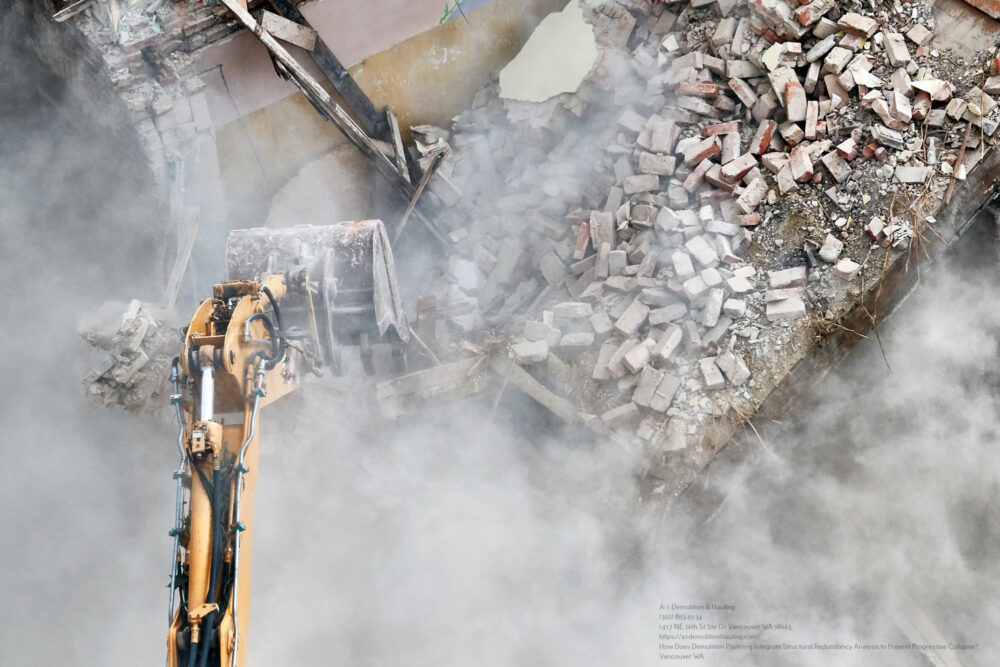
Removing Weight Gradually Prevents Force Redistribution
As demolition progresses, remaining structural components absorb changing loads. Without careful sequencing, those shifts can overload connections or destabilize nearby supports.
Professional crews often:
- Remove non-structural elements first
- Reduce upper-level loads gradually
- Maintain critical supports until the final phases
- Coordinate debris removal continuously
This method protects surrounding properties while supporting regulatory compliance and safer demolition conditions.
According to Labor & Industries (L&I) Washing State, demolition standards, engineering surveys are required before demolition begins to evaluate collapse risks and structural hazards. Those evaluations directly support redundancy analysis during structural demolition.
Need Safe Demolition Services for a Complex Structural Project?
Contact A-1 Demolition & Hauling today for experienced demolition planning and support.
Why Demolition in Vancouver WA Requires More Than Just Heavy Equipment
Large excavators and Concrete Cutting tools may be visible onsite, but the real work often happens during pre-demolition analysis.
What Contractors Evaluate Before Demolition Begins
Professional demolition contractors study:
- Structural drawings
- Renovation history
- Concrete structures
- Connection points
- Previous deconstruction activities
- Foundation behavior
Crews also perform Environmental Assessment reviews and Hazardous Material Assessment procedures to identify asbestos removal concerns, hazardous materials, and hazardous waste before structural work begins.
In demolition in Vancouver WA, this planning stage helps demolition services avoid progressive collapse conditions that could damage nearby buildings, underground utilities, or active construction zones.
The Hidden Risk Factors that Increase Progressive Collapse Potential
Progressive collapse occurs when one structural failure triggers another, setting off a chain reaction throughout the building. Some structures are naturally more vulnerable than others.
Older Renovations Often Create Structural Surprises
Buildings that underwent multiple remodels sometimes contain removed walls, altered framing, or unsupported spans hidden behind finishes. During selective demolition or Selective Building Interior Demolition, crews occasionally discover structural conditions that no longer match original drawings.
That’s why experienced demolition contractors never rely solely on old blueprints. They combine field inspections with structural redundancy analysis to verify actual conditions onsite.
House teardowns, single-family residential structures, and industrial facilities each present different risks. Even small sheds can behave unpredictably if loads are modified over time.
How Debris Management Supports Structural Stability During Demolition
Most property owners separate debris removal from structural planning. In reality, the two are closely connected.
Poor Debris Flow can Destabilize a Demolition Site
Construction and demolition (C&D) debris creates temporary loading conditions throughout the site. Piles of bulky waste, inert waste, or deconstruction waste can shift soil pressure and interfere with structural sequencing if materials aren’t removed efficiently.
That’s why experienced demolition contractors coordinate:
- Haul-off services
- Dump truck fleet scheduling
- Side-dump trucks
- Transfer stations
- Recycling company processing
- Disposal facility logistics
A cleaner demolition site supports better visibility, safer equipment movement, and more controlled load redistribution during demolition activities.
What Structural Redundancy Analysis Looks Like on Real Projects
Theory matters, but practical execution matters more.
A Real-World Example From a Commercial Demolition Project
During a structural demolition involving older office buildings, crews discovered hidden support modifications from prior tenant renovations. Initial drawings suggested certain beams were non-load-bearing. Field analysis revealed that those members were actively redistributing floor loads.
Instead of removing them immediately, the demolition contractor adjusted the sequencing and added temporary support measures during the demolition. That decision prevented progressive collapse and allowed safe continuation of site preparation and debris removal work.
This kind of adaptability sets experienced demolition services apart from crews that rely solely on equipment power.
Why Environmentally Friendly Demolition Techniques Depend on Good Planning
Structural redundancy analysis doesn’t just improve safety; it also enhances reliability. It also supports environmentally friendly demolition techniques.
Cleaner Sequencing Creates Cleaner Recycling
When demolition crews understand structural behavior, they can dismantle components more precisely, rather than crushing materials indiscriminately. That improves:
- Recycling practices
- Concrete recovery
- Scrap separation
- Post-construction debris cleanup
- Deconstruction waste processing
This matters for commercial demolition and residential and commercial deconstruction services alike. Cleaner material separation helps reduce landfill use while improving efficiency across the construction project.
Companies like Waste Connections and local transfer stations benefit from cleaner incoming waste streams because contaminated materials require more complex disposal procedures.
What Smart Property Owners Should Ask Before Hiring a Demolition Contractor
Price matters. But when progressive collapse risks are involved, planning matters more.
Questions Worth Asking During Contractor Selection
Does the contractor perform structural redundancy analysis? Do they evaluate previous renovations and hidden load paths? How do they manage hazardous materials and abatement and remediation requirements? Can they coordinate junk removal, foreclosure and estate cleanout work or hoarding cleanup services if needed during demolition?
Experienced contractors answer these questions clearly because safety planning is already built into how they operate.
In demolition in Vancouver WA, redundancy analysis has become one of the strongest indicators of a professional, well-prepared demolition contractor.
Why Choosing A-1 Demolition & Hauling is the Smart Decision
We at A-1 Demolition & Hauling provide the best solutions to our customers by combining careful demolition planning with real structural awareness before work begins. Our demolition services focus on preventing progressive collapse through proper sequencing, redundancy analysis, and controlled structural removal strategies.
Our team handles structural demolition, selective demolition, interior demolition, debris removal, concrete removal, Site Clearing, and residential and commercial deconstruction services throughout Vancouver, WA. We also support customers with junk removal, post-construction debris cleanup, foreclosure and estate cleanout services, and environmentally responsible waste handling practices.
We take pride in maintaining safe demolition conditions through strong planning, regulatory compliance, recycling practices, and responsible management of hazardous materials. From commercial buildings and industrial facilities to residential demolition and single-family residential structures, our approach prioritizes safety, organization, and long-term project stability.
Contact A-1 Demolition & Hauling today for professional demolition expertise designed to reduce risk and improve project control in demolition in Vancouver WA.
Need Safe Demolition Services for a Complex Structural Project?
Contact A-1 Demolition & Hauling today for experienced demolition planning and support.