The Hidden Engineering Behind Safe Demolition Projects in Vancouver, WA
Demolition looks dramatic from the outside, but the safest projects are the quietest ones. Behind every controlled teardown is a detailed plan that determines exactly what comes down, when, and why. Structural sequencing is the method professionals use to dismantle buildings in a specific order, so weight shifts never spiral out of control. In demolition in Vancouver WA, this approach protects workers, neighboring properties, and long-term project budgets.
For property owners and developers exploring demolition services, understanding sequencing explains why professional crews matter.
Professional demolition uses structural sequencing to control how weight moves through a building as it’s dismantled. By removing load-bearing elements in a calculated order, demolition crews prevent sudden collapses, reduce site risk, and maintain stability throughout the entire demolition process.
What Structural Sequencing Really Means on a Live Demolition Site
Structural sequencing is the planned dismantling of a structure based on how loads travel through it. Every building transfers weight from roofs and upper floors down through walls, beams, and foundations into the ground. When demolition ignores this reality, uncontrolled load transfer occurs, and that’s when accidents happen.
Why Load Paths Dictate Demolition Order
Load paths determine which components are safe to remove first. Non-structural elements are addressed early, while critical supports remain in place until surrounding loads are relieved. This method prevents stress from suddenly shifting into areas that weren’t designed to carry it.
People often ask, Why can’t crews knock everything down at once?
Because buildings aren’t balanced like stacks of blocks. They’re interconnected systems. In Vancouver, WA, where ground types vary and erosion control matters, sequencing becomes even more critical. Professional demolition accounts for soil behavior, moisture, and foundation response.
The Costly Consequences of Ignoring Structural Sequencing
When demolition sequencing is rushed or skipped, failures rarely happen immediately. Instead, they appear after unexpected load redistribution.
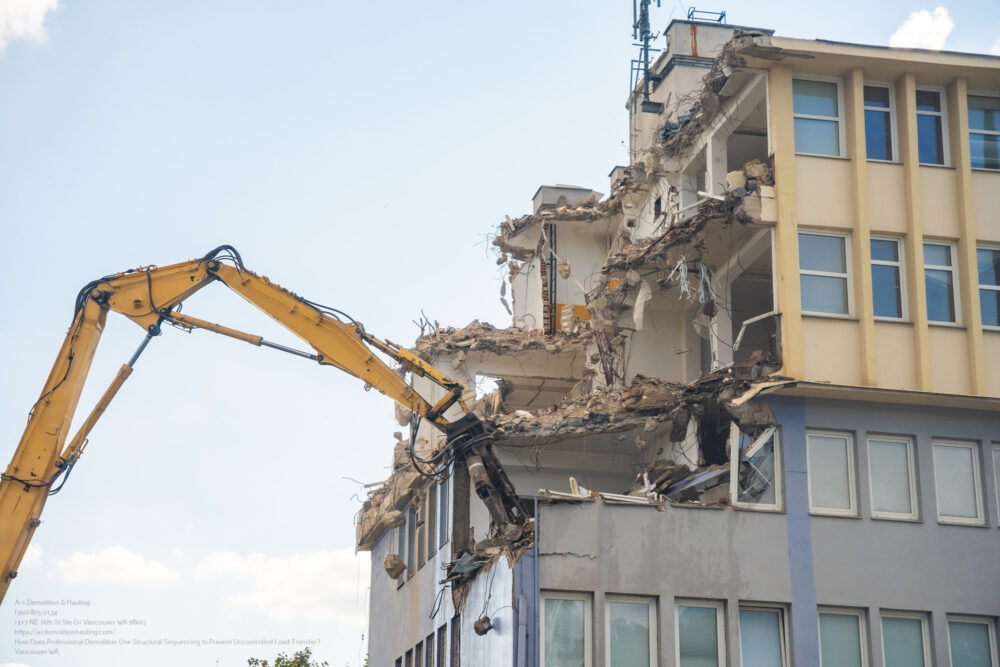
Some of the most frequent errors include removing load-bearing walls too early, cutting beams before relieving upper-floor weight, or relying on brute force instead of planning. Crews unfamiliar with heavy construction contracting services may underestimate how slabs, columns, and building pads interact.
These mistakes can result in:
- Partial structural collapses
- Damage to nearby parking lots or utilities
- Injuries to subcontractor onsite personnel
- Higher cleanup costs and project delays
According to OSHA demolition standards, structural evaluations are required before dismantling to prevent these exact risks. Companies like A-1 Demolition & Hauling use sequencing to align with these standards and avoid preventable failures.
Read more about demolition in Vancouver WA
Looking For Professional Demolition Services That Prioritize Safety and Precision?
Contact A-1 Demolition & Hauling today to discuss your project and get expert guidance you can trust.
Why Structural Sequencing Protects Property Owners and Project Budgets
From a client’s perspective, demolition isn’t just about removing a structure; it’s about managing risk. Proper sequencing protects surrounding buildings, limits vibration, and avoids costly surprises.
Predictability Builds Trust
Sequenced demolition creates predictable outcomes. That predictability supports honest business practices and long-term, profitable relationships. When developers know their demolition contractor understands load transfer, they’re more confident moving forward with excavation, erosion control, and site redevelopment.
For projects involving septic abandonment, mold removal coordination, or multiple excavating contractors, sequencing ensures every phase stays aligned. It’s one of the clearest indicators of a construction company that values planning over shortcuts.
How Professional Demolition Crews Engineer Safe Sequencing Plans
Sequencing starts long before equipment arrives on-site. Professional demolition teams analyze how a structure was built and how it will respond as elements are removed.
What Professionals Evaluate Before Demolition Begins
Crews assess materials, structural connections, foundation conditions, and surrounding infrastructure. They also plan equipment use, including conveyor trucks or specialized machinery, to safely manage debris flow.
A typical sequencing strategy includes:
- Removing non-structural components to reduce overall load
- Gradually relieving weight from the upper sections.
- Maintaining stability until primary supports are no longer needed
In Vancouver, WA, weather patterns and soil behavior further influence these decisions. That’s where experienced excavating contractors and demolition teams coordinate closely to maintain site control.
Real-World Demolition Insights from Local Projects
Theory only matters if it works in practice. Sequencing proves its value on real job sites every day.
A Practical Local Example
On a commercial demolition project near active parking lots, structural sequencing prevented cracking and settlement. Upper floors were dismantled first, reducing downward loads before foundation elements were addressed. Excavating contractors managed erosion control simultaneously, keeping the site stable throughout the process.
This kind of success doesn’t happen by accident. It requires strong knowledge across the entire organization and coordination between demolition crews, operators, and supervisors. That shared expertise is what separates exceptional construction contracting services from risky operations.
What Property Owners Should Remember about Demolition in Vancouver WA
In demolition in Vancouver WA, structural sequencing is the foundation of safe demolition. It minimizes risk, controls load transfer, and protects both people and property. It also ensures compliance with safety regulations and environmental considerations unique to the region.
For property owners, the takeaway is simple: sequencing isn’t an optional upgrade; it’s the baseline for professional demolition. Choosing a contractor who understands this principle means fewer surprises and better outcomes.
Why A-1 Demolition & Hauling is the Right Choice for Safe Demolition
We at A-1 Demolition & Hauling provide the best solutions to our customers by treating demolition as an engineered process, not a guessing game. Structural sequencing guides every demolition project we take on, ensuring uncontrolled load transfer never puts people or property at risk.
Our team delivers exceptional construction contracting services by combining field experience, strong knowledge, and coordination across our entire organization. From structural demolition to work involving building pads, excavating contractors, and erosion control, every step is planned with care.
We proudly showcase our demolition expertise through consistent execution, honest business practices, and a foundation of honor that clients trust. If you’re planning a demolition project, contact A-1 Demolition & Hauling for professional services. The difference shows in every safely completed project and in every successful demolition in Vancouver WA outcome.
demolition near me in Vancouver WA
Looking For Professional Demolition Services That Prioritize Safety and Precision?
Contact A-1 Demolition & Hauling today to discuss your project and get expert guidance you can trust.